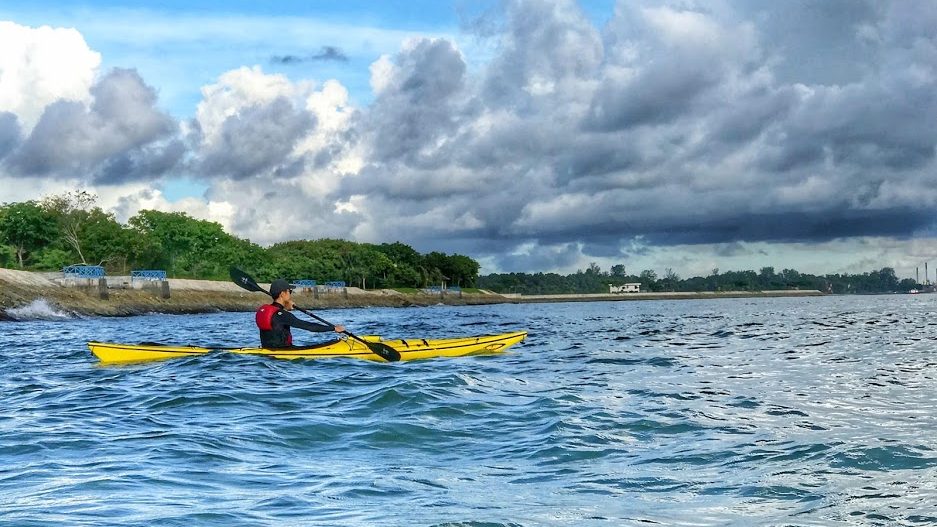
Like most people, I had my initial kayaking experience during my younger days. I had the chance to attend a kayaking orientation during my school days and enjoyed it. I wasn’t really a sporty person back then, but it somehow sparked the love for water later on in life.
It was only in 2012 when I decided to take on the kayaking certification. The long hiatus was due to my windsurfing days in university, that’s another story for another day. The main reason to go for the course was simply to just be able to rent the kayak and enjoy the sea. I have always enjoyed water sports and kayaking is a skill which I thought would be good to have.
So, I signed up for the one star course over a weekend at random and went on my own. It was easy, as I am quite comfortable with the sea as a windsurfer in university. The capsizing and learning how to understand the motion of the kayak was interesting. I am always fascinated by the movement of water, the fluidity of it and the energy it can hold. After the course, I felt that I wanted more. I realised there is much to learn in these certifications. It was about water awareness and safety, not so much on how fancy the strokes are.
Within half a year, I went on to take the two star course and completed it. There was much more satisfaction with the two star course. More techniques on rescuing and more compound strokes, making the maneuvers on the kayak smoother and easier. There was a bit more thinking to do in the course as I had to react according to how the kayak moves. The challenge was fun and fulfilling.
Of course, the next step will be to take the three star course. I hesitated for a while as that course is quite different from the previous two. The course and the assessment are separate events. In addition, there is a requirement to clock a number of expeditions. In 2018, I decided to take the plunge and try for it. I read up on it knowing that it wasn’t easy to get the certification and thought that I should just give it a try. Even if I am not certified, at least I went through the course to learn something- that became the main aim.
The three star course was spread out over four sessions, totaling 24 hours. There was the theory part and the technical part. The theory part was not too difficult and easily managed. The technical part was heavy on content and skills. A number of skills were advanced versions of the previous courses and more demanding in the aspect of execution. This was mainly to be able to deal with more tricky water conditions which required more advanced recovery methods and proficiency. I did get very tired over the sessions as it was physically demanding and used parts of the body that I did not know exists. Kayaking is not about just the arms, but primarily on the core to be able to be one entity with the kayak. The advance rescue methods are interesting and whatever is taught is based on principles and concept. Water conditions change all the time, so the techniques cannot be fixated on a particular way of execution. It is more important to know which technique suits which condition and how it can be executed safely. The four sessions were completed, but that was just the beginning. It is up to the individuals to practise and hone the skills- the water time during the course will not be enough. The most tricky of it was the eskimo roll, it is something that can be achieved during the course, but to have a constant success rate, there needs to be practise.
After the course, I went on to fulfil the next part of the requirement for the three star certification- expeditions. So, I took the opportunity to practise the different strokes during the five 8 km journeys, while exploring different parts of the coast. I practiced at Sembawang, Pasir Ris, Pulau Ubin and Southern Islands. It was fun going to these places to explore the sea, as each of these coastlines have different characteristics. I also signed up for the three star revisit course to get help with improving the rolls and the strokes. It was done in a swimming pool setting, which helps to eliminate the sea factors, to focus on the skills. I found it useful as I could see what happens underwater, to figure out exactly how to execute a move.
With all the practice, I felt confident enough to take the assessment. It was a bit like taking my driving license test, there was some anxiety but put in a positive way. I realised that the main thing about kayaking is to always stay relaxed and calm (always true for any water sport). I went through all the assessment parts and most of it was smooth without hiccups. Once back on land, the assessor tabulated the scores and the announcement came. I made it and was very glad with myself, a sense of achievement.
With that three star certification, I am reminded of how much recreation water can bring and also the dangers of it. It helps me understand the water better and how I can move with it to my advantage. Kayaking is indeed a fun and challenging sport, that requires strength and cognition of nature.